

 Blog
Hunt blog › Everyday India online
Shopping online safely: fake sale sites, cash on delivery and returns
How to spot a fake sale site, when cash on delivery helps, how real refunds work, and where to complain in India if an online order goes wrong.
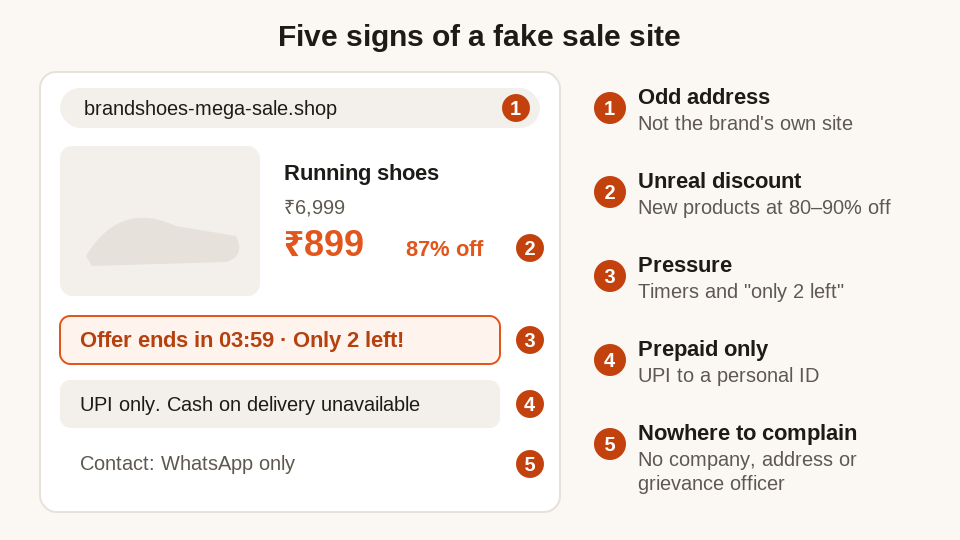
Imran in Lucknow saw an ad between two reels: branded running shoes, usually ₹6,999, now ₹899 in a "festive clearance". The site looked polished. A timer said the offer ended in four minutes, and only UPI was accepted. He paid. The shoes never came, the site vanished a week later, and the number on it was switched off.
Online shopping in India is mostly safe and very convenient. The trouble sits at the edges: sites that exist only to take payments, pressure tricks on real sites, and "refund" calls that empty accounts. The habits that protect you are simple, and they don't need any technical skill.
Rules and numbers here were checked on official pages of the Department of Consumer Affairs, the Press Information Bureau, the National Consumer Helpline and the Reserve Bank of India in October 2026.
How a fake sale site works
A fake shop is cheap to make. Someone copies product photos, writes a few cheerful lines, buys a new web address and pays for ads on social media. The goal is not to deliver anything. It is to collect as many payments as possible before people complain, then move to a new name.
The same signs show up again and again:
- The address is odd. A brand name with extra words, a strange ending, or a spelling that is almost right, such as
brandshoes-mega-sale.shopinstead of the brand's own site. - The discount is unreal. 80 to 90 percent off new, popular products is not a sale, it is bait.
- There is a countdown or "only 2 left". The pressure is there so you don't stop to check.
- Only prepaid payment is accepted. Usually UPI to a personal-looking ID, with cash on delivery "temporarily unavailable".
- There is nowhere to complain. No company name, no address, no grievance officer, and a phone number that is only on WhatsApp.
One sign alone can be innocent. Three together should make you close the tab.
Check a shop in five minutes
Before buying from a site you have never used, spend five minutes on these checks. It is the cheapest insurance there is.
- Read the address bar, not the page. Type the shop's name into a search engine yourself and compare. If an ad brought you there, be extra careful.
- Find the seller details. Under India's Consumer Protection (E-Commerce) Rules, 2020, online shops must have a grievance officer and show their name and contact details on the platform. A shop with none of this is not following the rules.
- Read the return and refund policy before you pay, not after. Look for how many days you get and who pays for the return pickup.
- Search the shop's name with "fraud" or "review", and read what people say on sites other than the shop itself.
- Look at the payment page. A real checkout shows the order total and a proper payment gateway. A page that just says "send ₹899 to this UPI ID and share the screenshot" is not a shop.
Pressure tricks on real sites
Not every problem comes from fake shops. Real apps also use design tricks that push you to spend more or agree to things you didn't mean to. India's Central Consumer Protection Authority issued Guidelines for Prevention and Regulation of Dark Patterns on 30 November 2023, listing 13 such practices as unfair. A few you will recognise:
| Trick | What it looks like |
|---|---|
| False urgency | "Only 1 left!" or a timer that resets when you reload |
| Basket sneaking | A donation, insurance or "protection plan" added to your cart without asking |
| Drip pricing | Fees that appear only at the last step |
| Subscription trap | Easy to sign up, very hard to cancel |
| Confirm shaming | "No thanks, I don't like saving money" as the cancel button |
| Disguised ads | Ads made to look like reviews or news |
The habit that beats all of them: look at the final amount on the last screen before you pay, and remove anything you didn't choose.
More help is on the way. Amendments to the e-commerce rules come into force on 1 January 2027. Among other things, when a shop announces a price cut it will have to show the earlier price too, and that earlier price must be the lowest one from the 30 days before the offer. Sponsored listings will have to be clearly labelled.
Cash on delivery: when it helps
Cash on delivery (COD) is popular for a good reason: you don't pay until something arrives. With a shop you don't know yet, it limits what you can lose.
It is not a guarantee, though. A box can arrive with the wrong item, or a brick, and once you have paid the delivery person, getting the money back depends on the seller. A few habits help:
- Check the sender and order number on the parcel before paying. If you didn't order it, refuse it, even if the amount is small.
- Pay exactly the amount shown in your order, not a different figure someone gives you at the door.
- Record the unboxing of expensive items on your phone, with the label visible. It makes a return claim much easier.
- Be wary of "pay a small fee to release your parcel" messages. Couriers don't collect COD by sending you a payment link from an unknown number.
Returns and refunds without the risk
A real refund is boring. You raise a return in the app or on the order page, a pickup is arranged or you drop the item off, and the money goes back to the card, account or wallet you paid with. You don't need to call anyone or approve anything with a PIN.
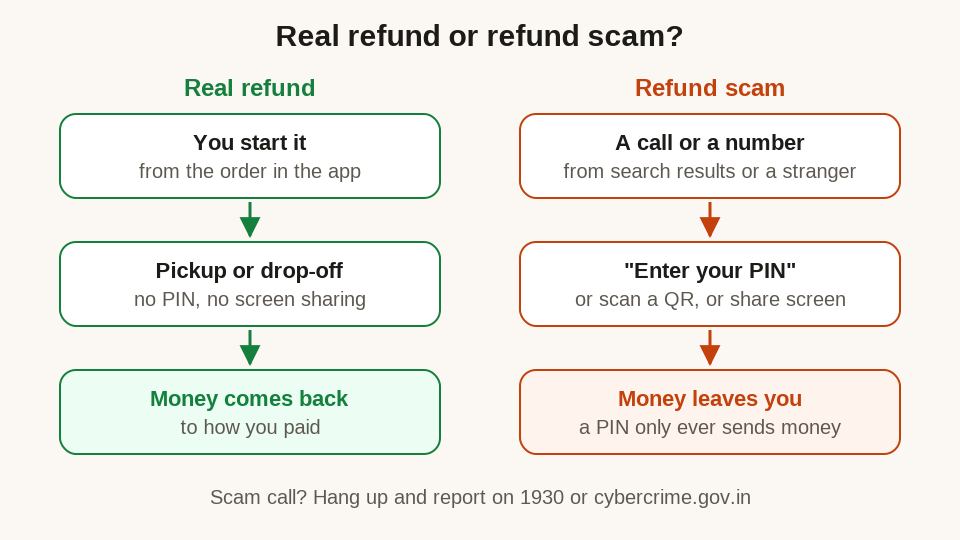
Refund scams follow a different script. Someone calls about "your order", or you search for a customer care number and call the first one you find. The "agent" is friendly and in a hurry. They ask you to install a screen-sharing app, scan a QR code or enter your UPI PIN, and the money goes the other way.
To stay on the real path:
- Start every return from the order itself, in the app or website where you bought it.
- Find customer care numbers inside the app, under Help or Contact Us. Don't trust numbers from search results, comments or social media posts.
- Never install an app because a caller asks you to.
- Keep the paperwork: order number, invoice, chat transcripts and photos, until the refund has reached your account.
If something goes wrong
Start with the seller or platform, in writing, so there is a record. If the shop follows the rules, its grievance officer must acknowledge your complaint within 48 hours and resolve it within one month.
If that doesn't work, India has free help:
- National Consumer Helpline (NCH): call 1915 (toll-free), or send a WhatsApp message or SMS to 8800001915. You can also register a complaint at consumerhelpline.gov.in or through the NCH and UMANG apps. It works in 17 languages. In 2025, about 29 percent of the 17.7 lakh complaints NCH received were about e-commerce, so you won't be the first.
- Consumer commission: if the dispute goes further, complaints to district, state and national consumer commissions are filed online on e-Jagriti. You don't need a lawyer to file.
- Cyber fraud: if money was taken by a fake site or a scam call, report it quickly on 1930 or cybercrime.gov.in, and tell your bank. Speed matters, because reports can help hold the money before it moves on.
Questions
How do I know if a shopping website is real?
Check the address bar for the exact name, look for the company's name, address and grievance officer, and read the return policy. Search the shop's name with "review" or "fraud" on other sites. Unreal discounts, countdown timers and prepaid-only payment together are strong warning signs.
Is cash on delivery safer than paying online?
With an unknown shop, it limits your risk, because you pay only when something arrives. It doesn't protect you from a wrong or empty box, so check the sender and order number before paying and record the unboxing of costly items.
Someone says I must enter my UPI PIN to get a refund. Is that real?
No. You only enter your UPI PIN to send money, never to receive it. A caller asking for your PIN, a QR scan or screen sharing for a refund is running a scam. Hang up and report it on 1930 or cybercrime.gov.in.
Where can I complain about an online shopping problem in India?
First complain to the seller or platform in writing. Then contact the National Consumer Helpline on 1915 or WhatsApp 8800001915, or at consumerhelpline.gov.in. For larger disputes you can file with a consumer commission on e-Jagriti. For fraud, report on 1930 or cybercrime.gov.in.
What are dark patterns in online shopping?
They are design tricks that push you into choices you didn't intend, like fake urgency, items added to your cart without asking, or fees shown only at the end. India's 2023 guidelines list 13 of them as unfair trade practices. Always review the final amount before paying.
Sources
- National Consumer Helpline: 1915, WhatsApp and SMS 8800001915
- Grievance officer to acknowledge in 48 hours and redress in one month, Consumer Protection (E-Commerce) Rules 2020, PIB
- Government amends E-Commerce Rules, in force from 1 January 2027, PIB
- CCPA issues Guidelines for Prevention and Regulation of Dark Patterns, 2023, PIB
- Guidelines for Prevention and Regulation of Dark Patterns, 2023 (full text), CCPA
- e-Jagriti frequently asked questions
- Be aware: receiving money never needs a PIN, Reserve Bank of India
- Cyber Crime Helpline 1930, National Cyber Crime Reporting Portal
Hunt Browser blocks ads and trackers before they load, and has Hunt AI built in. Free for Windows and Mac.
Keep reading
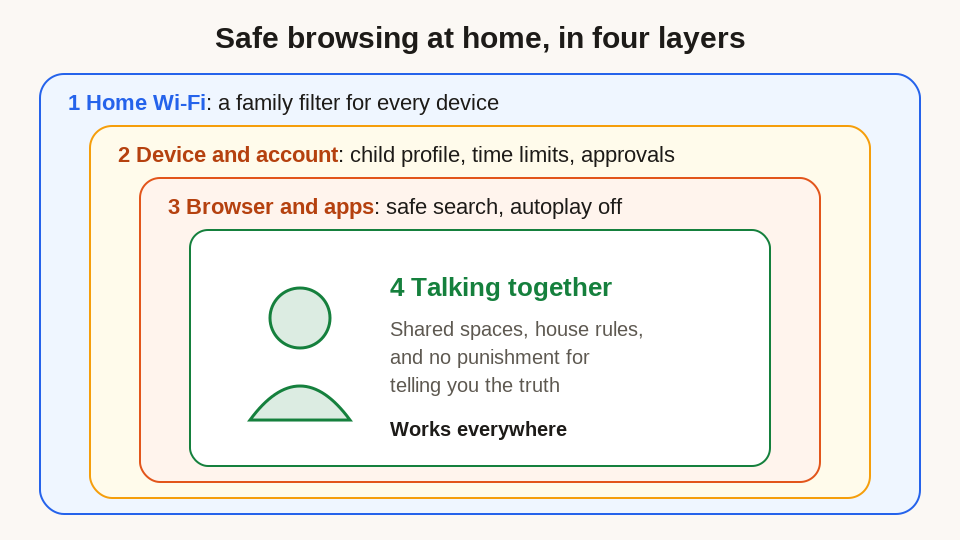
Setting up safe browsing for children at home
A calm, layer-by-layer setup for children's browsing at home, from the Wi-Fi router and phone to the browser and house rules, and what to do if things go wrong.
7 November 2026 · 8 min read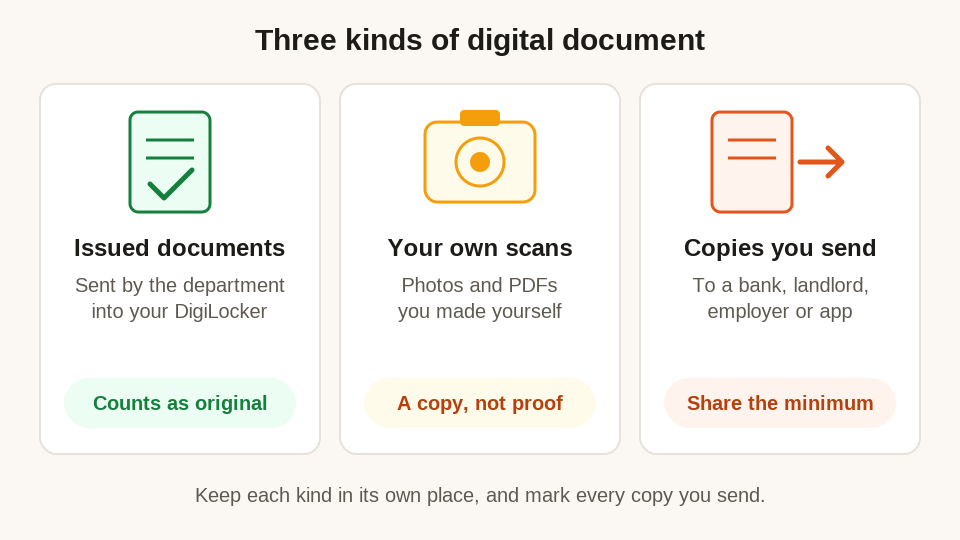
Keeping your documents digital and safe: DigiLocker, PDFs and photos
How to keep Aadhaar, PAN, marksheets and licences on your phone safely, when a DigiLocker copy counts as the original, and how to share a copy without risk.
5 November 2026 · 9 min read
Train travel online: PNR status, waitlists and booking tips
What your PNR status means, how a waitlist moves, when Tatkal opens and what cancelling costs, with every rule checked on official railway sites.
4 November 2026 · 10 min read