

 Blog
20 everyday AI prompts for students, shopkeepers and office workers
Twenty ready-to-use AI prompts for studying, running a shop and office work, plus the four parts of a good prompt and what never to paste into an AI tool.
Most people try an AI tool once, type something like "write a message for my shop", get a stiff paragraph that sounds nothing like them, and decide it isn't useful. The tool wasn't the problem. It simply had nothing to go on.
An AI tool is like a smart new assistant on their first day. They are quick and willing, but they don't know your customers, your college or your boss. The more you tell them, the better the work. That is all "prompting" really means: giving clear instructions with enough detail.
Below are the four parts of a good prompt, what to keep out of any AI tool, and 20 prompts you can copy, fill in and use today. Replace the words in [square brackets] with your own.
The four parts of a good prompt
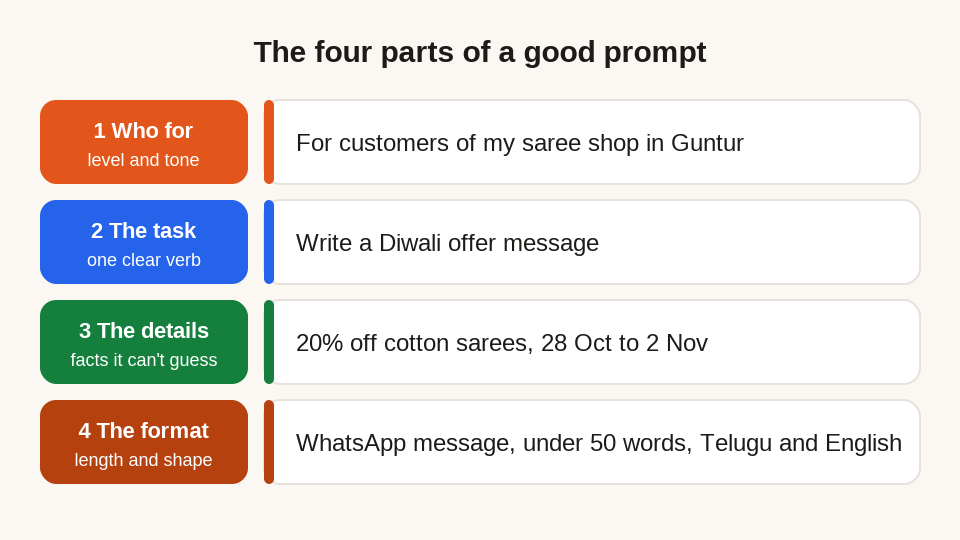
You don't need special words or tricks. A useful prompt usually answers four questions.
- Who is it for? A Class 9 student, your customers in Warangal, your manager. This sets the level and the tone.
- What is the task? Explain, draft, list, compare, check, plan. One clear verb.
- What are the details? The facts the tool can't guess: dates, prices, names, your notes, what went wrong.
- What should it look like? Five bullet points, a WhatsApp message under 60 words, a table, Hindi and English.
One AI company's prompting guide suggests a simple test: if you handed your prompt to a colleague who knows nothing about the job, would they understand what you want? If not, the AI won't either.
What never to paste into an AI tool
AI tools in the cloud send what you type to their company's servers. Most keep chats for some time, and some use them to improve their models if your settings allow it; the tool's privacy settings say which. Treat a prompt like a message to a very helpful stranger.
You rarely need the real details anyway. "Customer A ordered 3 sarees" works as well as a real name and number.
For students
1. Explain a topic at your level
Explain [photosynthesis] to me like I'm in [Class 10]. Use one everyday example from India, then give me three short questions to check I understood.
The questions at the end turn reading into practice.
2. Quiz me, one question at a time
Quiz me on [the French Revolution, Class 9 CBSE]. Ask one question at a time and wait for my answer. Tell me if I'm right, explain briefly, then ask the next. Ten questions.
Asking it to wait stops it from printing all the answers at once.
3. Turn notes into flashcards
Turn these notes into 15 flashcards. Front: a question. Back: an answer under 20 words. Notes: [paste your own notes]
Use your own class notes, not a random web page, so the cards match what your teacher taught.
4. Plan your revision
I have [12] days before my [semester exams]. Subjects: [list], and I'm weakest in [Accounts]. I can study [4] hours on weekdays and [7] on Sundays. Make a day-by-day plan with short breaks and two revision days at the end.
5. Get feedback without a rewrite
Here is my essay on [water scarcity in Chennai]. Don't rewrite it. List the three biggest weaknesses in the argument and one sentence that's unclear. [paste essay]
Telling it not to rewrite keeps the work yours, and many schools and colleges have rules on AI-written assignments.
6. Understand a word in your language
What does [पारिस्थितिकी तंत्र] mean? Explain in simple Hindi and in English, with one example sentence in each.
7. Practise for a viva or interview
Act as an interviewer for a [campus placement for a junior accountant]. Ask me one question at a time. After each answer, give one tip to make it stronger.
For shopkeepers and small businesses
8. A festival message for customers
Write a short WhatsApp message for customers of [Lakshmi Textiles, Guntur]. [Diwali] offer: [20% off cotton sarees, 28 Oct to 2 Nov]. Friendly, under 50 words, in Telugu and English.
Give the real offer and dates. If you don't, the AI may invent a discount you never planned.
9. Reply to an unhappy customer
A customer wrote: "[paste message]". Draft a polite, short reply. Say sorry for the delay, explain [the courier was late because of rain], and offer [free delivery on the next order]. Don't promise a refund.
Saying what not to promise matters as much as what to say.
10. A product description
Write a product description for [a 5-litre stainless steel pressure cooker] for my online store. Facts: [brand, size, what's in the box, warranty]. 60 words, simple English, no exaggeration.
11. Tidy a messy order list
Turn these order notes into a table with columns Item, Quantity, Price and Total, and add a grand total at the bottom: [paste notes]
Check the totals yourself. AI tools can make arithmetic mistakes, especially in long lists.
12. A shop notice
Write a short notice for my shop board: closed on [Sunday 9 November] for a family function, open as usual on Monday from [9 am]. Polite, in Hindi and English, big and simple.
13. Thank a customer for a review
A customer left this review: "[paste review]". Write a warm two-line reply that thanks them by first name and mentions [the item they bought].
14. Ideas for a slow week
I run a [small bakery in Mysuru]. Weekday afternoons are slow. Suggest five low-cost ideas to bring in customers, each in one line, and say which needs no money at all.
For office workers
15. An email thread into actions
Here is an email thread. List the decisions made, the open questions, and who must do what by when, as a table. [paste thread, with names changed if needed]
16. A polite follow-up
Write a short, polite follow-up email to [a vendor] about [the invoice sent on 3 October that hasn't been paid]. Firm but friendly, under 100 words.
17. Meeting notes into minutes
Turn my rough meeting notes into clear minutes: attendees, three key points, decisions, and action items with owners and dates. [paste notes]
18. Explain a spreadsheet formula
Explain this spreadsheet formula step by step in plain words, then tell me what happens if the cell is empty: [paste formula]
19. Say it more clearly
Rewrite this message so it's clearer and more polite, but keep my meaning and keep it short. It's going to [my team lead]. [paste message]
20. Prepare for a hard conversation
I need to ask my manager for [two weeks of leave in December for my sister's wedding] during a busy month. Help me plan what to say: the main points, a likely objection, and a calm answer to it.
When the first answer isn't right
Don't start over. Reply in the same chat and steer it:
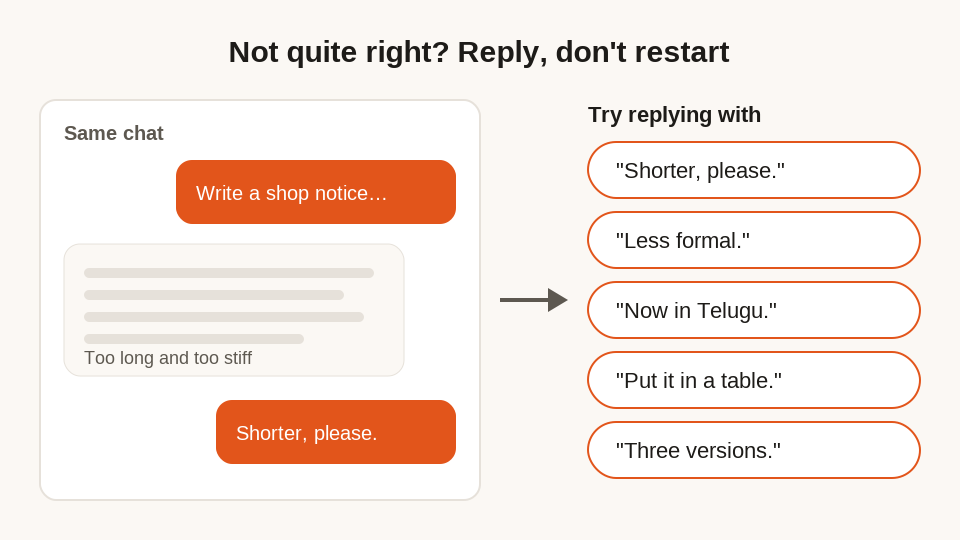
- "Shorter, please. Half the length."
- "Less formal. It's for my regular customers."
- "Now the same in Telugu."
- "Put that in a table."
- "Give me three different versions."
If it keeps missing your style, paste one of your own past messages and say "Write it like this." An example teaches tone faster than any description.
Check before you send
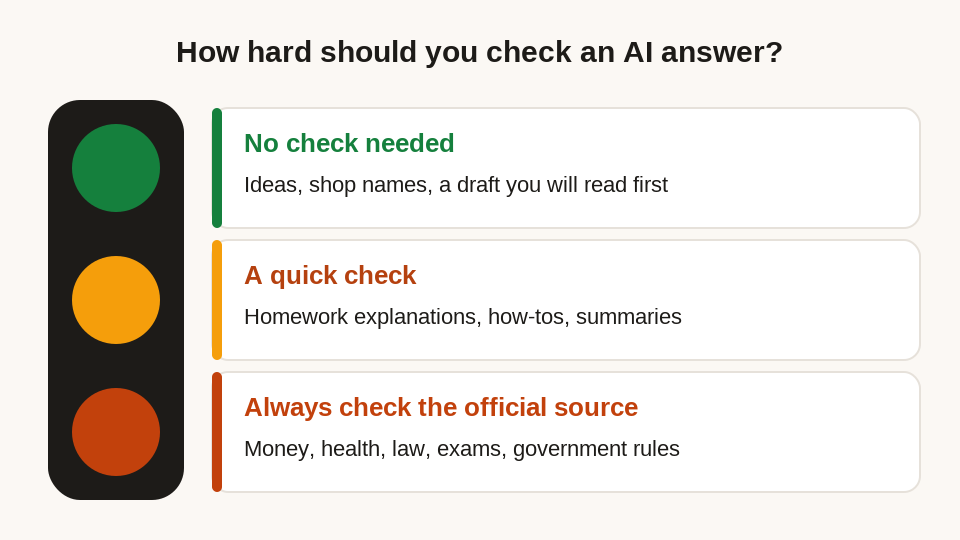
AI tools can sound confident and still be wrong. Before you send or submit anything, read it fully and check every name, date, price and number against your own records. If the answer contains a fact you didn't give it, such as a rule, a statistic or a deadline, check it on an official source. Our guide on checking an AI answer in two minutes shows how.
Trying these in Hunt Browser
In Hunt Browser on Windows and Mac, Hunt AI sits in the side panel. After a one-time download of the free on-device model (on Wi-Fi), it can explain things, translate and draft replies on your own computer, with no account, which suits prompts with private details. Write, which fixes grammar and changes the tone of your text in English, Hinglish and Indian languages, needs a Hunt account, and sign-in is coming soon.
Questions
Do I need to write prompts in English?
No. Most AI tools understand Hindi, Telugu, Tamil and other Indian languages, and Hinglish too. You can also ask in English and request the answer in another language. Results in Indian languages can be less polished, so read them carefully before you send them to anyone.
Why does the AI give a different answer every time?
AI tools add some variety on purpose, so the same prompt can give different wording each time. That's useful when you want options. If you need a consistent result, give more detail and an example of what you want.
Is it cheating to use AI for homework?
It depends on your school or college rules, so check them. Using AI to explain a topic, quiz you or find weaknesses in your essay helps you learn. Submitting AI-written work as your own usually breaks the rules and skips the learning.
Can I trust AI with calculations?
Not fully. AI tools can make arithmetic mistakes, especially with long lists of numbers. Use them to set up a table or explain a formula, then check totals with a calculator or spreadsheet.
Sources
- Prompting best practices: be clear and direct, Anthropic documentation
- Is my data used for model training? An AI company's privacy help page, as an example of these settings
- India's finance ministry asks employees to avoid AI tools, Reuters via The Kathmandu Post (February 2025)
- Hunt AI on your device, Hunt Browser features
- Write, Hunt Browser features
Hunt Browser blocks ads and trackers before they load, and has Hunt AI built in. Free for Windows and Mac.
Keep reading
When AI gets it wrong: how to check an AI answer in two minutes
AI answers sound sure even when they're wrong or out of date. Which answers need checking, a two-minute method, and the red flags that should make you stop.
12 November 2026 · 9 min read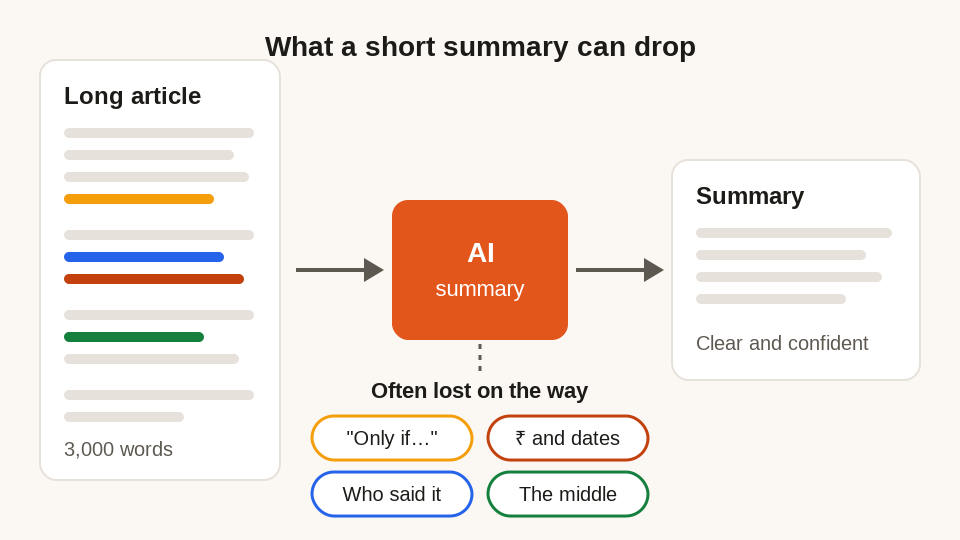
Using AI to summarise long articles without missing the point
AI summaries save time but drop conditions, numbers and who said what. How to ask for a better summary, and a three-step check before you rely on it.
10 November 2026 · 10 min read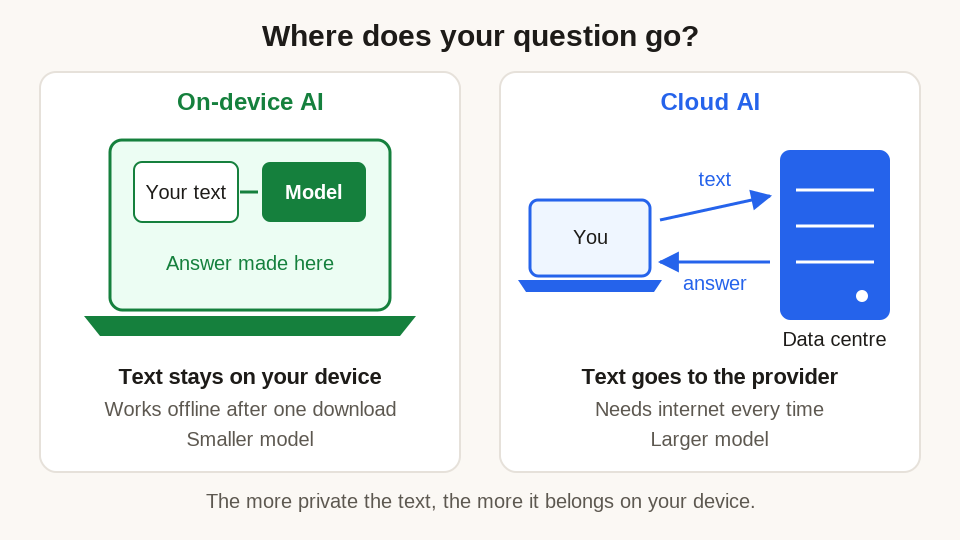
On-device AI and cloud AI: what's the difference, and why it matters
Where an AI tool runs decides who sees your text, whether it works offline, how fast it is and how good the answers are. A plain guide to choosing.
8 November 2026 · 8 min read